|
|
7 reasons why you need to know what your business is worth |
|
Ask most business owners what their house is worth and they'll give you a figure within a few thousand pounds. Ask about their pension and they'll quote it almost to the penny. Ask what their business is worth and the answer is usually a range, a rumour, or a multiple someone mentioned at a networking event. That's an odd gap, because for most owner-managed businesses, the company is wealth, retirement, family legacy and income, wrapped into a single number that most owners have never actually pinned down. A sale eventually forces that number into the open. But a sale is only one of at least seven moments when knowing your value stops being nice to know and starts being necessary. The danger was never really about getting the number wrong. It's discovering it too late, once the decision it should have informed has already been made. In this newsletter, we’ll unpack the other six reasons through the lens of a UK-based business owner. However, the underlying principles still apply no matter where you are in the world. |
1. Succession, estate planning and IHT
|
 |
In April this year, the rules around Business Relief and Agricultural Relief changed materially. The first £2.5m of combined qualifying business and agricultural property will still attract 100% relief from inheritance tax. Above that threshold, relief drops to 50%, which works out to an effective 20% charge on the excess. Unused allowance can transfer between spouses and civil partners, but the days of an unlimited, uncapped relief have ended. For a business valued at £8m, that means £5.5m is exposed at the new rate, roughly £200,000 of additional IHT exposure for every £1m above the allowance. The assumption "it's my trading business, Business Relief will deal with it" no longer holds by default. That's a comfortable assumption to have carried for years and an expensive one to keep carrying past April 2026 without checking it. If your estate plan depends on the value of your business, you need to actually know that value, not assume it, you need to know it now rather than when the estate is being wound up. |
2. Shareholder changes, disputes and partner exits
|
 |
Divorce, a partner leaving, a dispute between shareholders, a death that triggers succession. Each of these raises the same underlying question in a different guise: what is this business, or this shareholder's stake in it, actually worth? And in each case, someone needs an answer, often on a timetable they didn't choose, at a moment they'd rather not be dealing with it. Value is easy to agree on in principle and much harder once money is actually on the table. A departing shareholder wants a generous number. The remaining shareholders want a conservative one. A divorcing spouse's advisors will have their own view entirely. This is precisely the environment in which an independently established, pre-existing valuation earns its keep. A valuation taken before a dispute does more than settle a number. It benchmarks the business and can expose weaknesses in shareholder agreements or succession plans while there's still time to fix them, rather than after positions have hardened and every party has a financial incentive to disagree with each other. |
3. Tax events, EMI and share schemes
|
 |
Granting EMI options, running a share scheme, or bringing in management through a buy-in all require a defensible valuation and not just a plausible one. HMRC's Shares and Assets Valuation team reviews values submitted for tax purposes and where it disagrees, it can propose an alternative figure and negotiate from there, with unresolved cases potentially reaching the tax tribunal. An agreed EMI valuation is generally only valid for 90 days, so this isn't a box you tick once and forget about as the business grows. The real question HMRC is asking isn't "can you produce a number?" It's "can you defend how you got there?" That means evidence, methodology, clearly stated assumptions, independence and proper documentation, not just a figure pulled from a conversation with your accountant. Get it wrong on a scheme worth a few million and the consequences may feel manageable. Get the same assumption wrong once the business has grown considerably and yesterday's shortcut becomes a very expensive one to unwind.
|
4. Raising capital and EIS
|
 |
Bringing in new investors means giving away equity and you can't judge whether the terms are fair without knowing what you're actually giving away a share of. EIS fundraising in particular depends on a valuation that will stand up to scrutiny on qualifying terms, both for the company raising capital and the investors relying on the relief. A founder who doesn't have a firm handle on valuation going into a raise is negotiating from a position of uncertainty, which rarely works in their favour. Get it wrong at an early stage and it might feel academic, a rounding error in a small raise. Build a £15m business on the back of that early decision and it stops being academic very quickly, because the dilution and the precedent it set are now baked into the cap table.
|
5. Shareholder protection and key-person considerations
|
 |
Shareholder protection and key-person cover are only as useful as the sums insured behind them. If those figures were set years ago, or never properly calculated at all, the cover in place may bear little relation to what the business, or a shareholder's stake in it, is actually worth today. A policy that felt generous at inception can quietly become inadequate as the business grows, leaving a real gap that nobody notices until it's needed. This is one of the easier triggers to overlook, precisely because the cover already exists and feels like a solved problem. It's worth revisiting periodically rather than assuming the original figures still hold. |
6. Growth, acquisitions and strategic planning
|
|
|
 |
Growth decisions, acquisitions and strategic planning all benefit from a clear-eyed starting point. It's hard to judge whether a deal creates value, or what a fair price for an acquisition target looks like, without a solid handle on what your own business is worth as the baseline. Strategic decisions made without that anchor point are, in effect, decisions made on instinct rather than evidence, even when they're dressed up in careful analysis of the target. |
7. Preparing for an eventual sale
|
 |
And yes, a sale itself. This is the trigger most owners associate with valuation and it remains an important one. But treating it as the only trigger, the one moment when the question of value finally gets asked, is where the real risk lies. Preparing early means the number isn't a surprise when it finally matters most and it gives an owner time to address anything in the business that might be suppressing that number before a buyer ever sees it. |
What waiting actually costs
|
Across all seven, the pattern is the same. Waiting until the event has already happened means less choice, because you're reacting rather than planning. A valuation is most useful when it informs a decision, not when it's commissioned after the fact to explain one. Three questions worth asking yourself:
What is my business worth today? What trigger would require a valuation and how prepared am I for it? Would that number hold up if somebody challenged it? If you can't answer all three with confidence, that's worth addressing before circumstances force the question. |
Introducing valuation insights
|
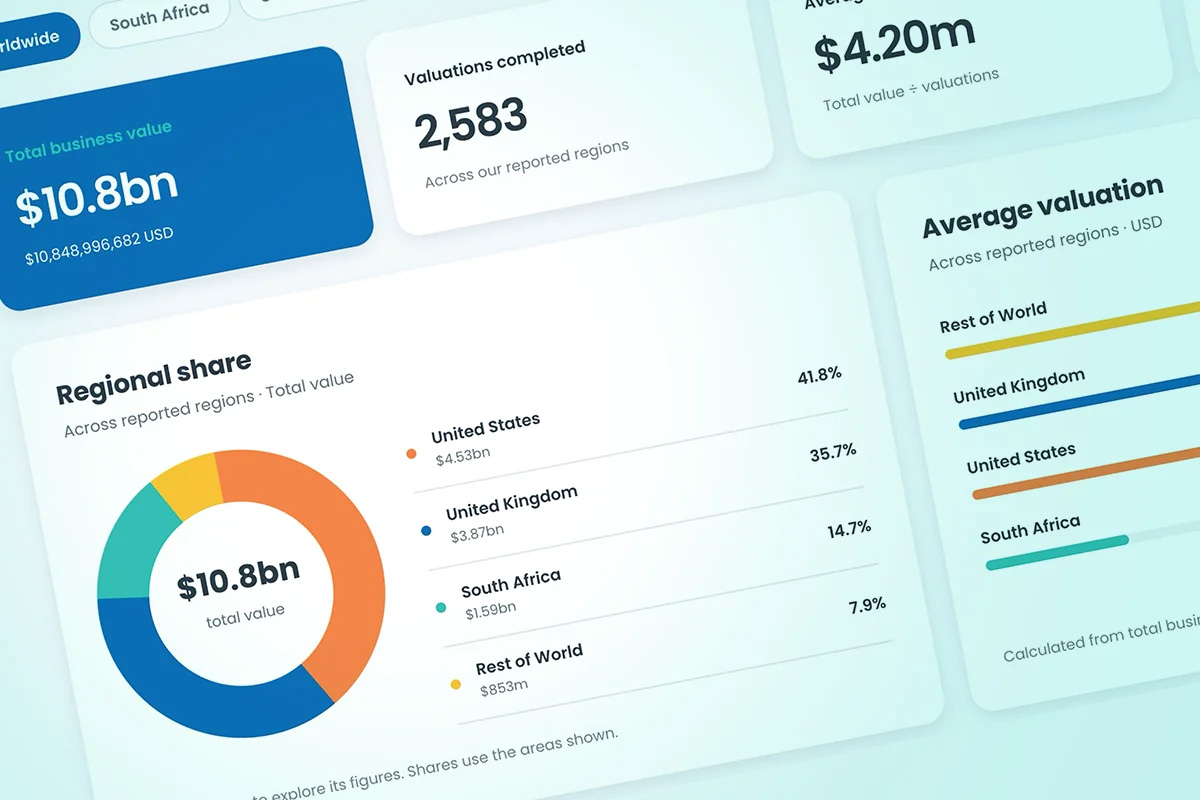 |
When you’re choosing a valuation partner, it helps to see where they’ve done the work. We’ve launched valuation insights, a new feature on the bizval website that lets you explore our valuation experience across regions and sectors. The interactive globe and dashboard bring together more than 2,500 completed valuations, representing over $10.8bn in business value.
You can select a region, explore the 20 sectors represented in our work and see how that experience spans the UK, US, South Africa and beyond. Whether you’re an owner considering a valuation or an advisor looking for support with a client engagement, it’s a straightforward way to get a better sense of the experience behind our reports.
Explore valuation insights here. |
 |
Recent podcasts
|
What happens when a valuation crosses a border?
In this episode, Graham speaks with Theresa Zeidler, who leads the US and UK valuation practices at KNAV, about which valuation principles hold up on both sides of the Atlantic and where local differences matter. The underlying questions may be familiar, but the definitions, credentials and ways of using multiples do not always translate as neatly as people assume.
Theresa and Graham discuss why fair value and fair market value are not interchangeable, what professional judgement actually involves and why a credible valuation needs to explain the thinking behind the number. They also look at how valuers protect their independence within a firm that provides other advisory services.
If you own a business with international interests, are considering an overseas sale, or advise clients across jurisdictions, this is a practical conversation about the assumptions worth checking before taking a valuation across a border.
Listen to the full episode here. |
|
|
Why the real test of an exit comes after the deal closes In this episode, Graham speaks with Beck Sydow, former CEO and COO of StickerGiant and founder of HumanKind Business Leaders. Beck and Graham discuss what buyers actually value in a business and whether culture counts toward that value or only looks good in the brochure. They also get into how owners can think more carefully about growth and preparation and what the realities of a sale look like from the inside. If you are preparing for an exit, advising a growing company, or rethinking what success means to you, this is a conversation about building value without losing sight of the people behind the business. Listen to the full episode here. |
|
|
Raising capital when the exit door is narrow In this episode, Graham speaks with Samuel Mokorosi, Head of Origination and Deals at the JSE, about what happens when a business needs to raise money or create an exit and there is no listed price to work from. The number of JSE-listed companies has fallen from close to 600 to below 300 and Samuel and Graham discuss what that means for where value is really being built. Throughout, the question of valuation keeps resurfacing. Once there is no screen price, value stops being something you look up and becomes something you have to establish. The episode also looks at where independent valuation fits alongside the platforms, advisors and lawyers who get a deal over the line. If you advise private companies, or own shares in one, this is a practical look at how capital and liquidity work when the market isn't doing the pricing for you. Listen to the full episode here. |
Building businesses that investors believe in
|
bizval and Citadel recently came together in Durban to host an evening of honest conversation, shared experiences and meaningful connections with fellow business owners.
Held at Coastlands Skye Hotel, the evening brought together entrepreneurs and business owners for a relaxed evening of good food, engaging conversation and the opportunity to connect with others navigating the realities of building and growing a business.
The evening featured a panel discussion with Graham Stephen, CEO of bizval, Mark JG Taylor, CEO of Cala Capital Africa and Paul Malherbe from TAB. The discussion created an open and engaging environment for business owners to share perspectives and experiences around growth, succession, funding and building long-term value.
More than anything, the evening was about bringing business owners together in an informal setting where genuine conversations could take place, ideas could be exchanged and relationships could be strengthened.
bizval would like to thank Citadel for co-hosting the event and everyone who joined us in Durban for a memorable evening of connection, conversation and community. |
Thank you for joining us in London
|
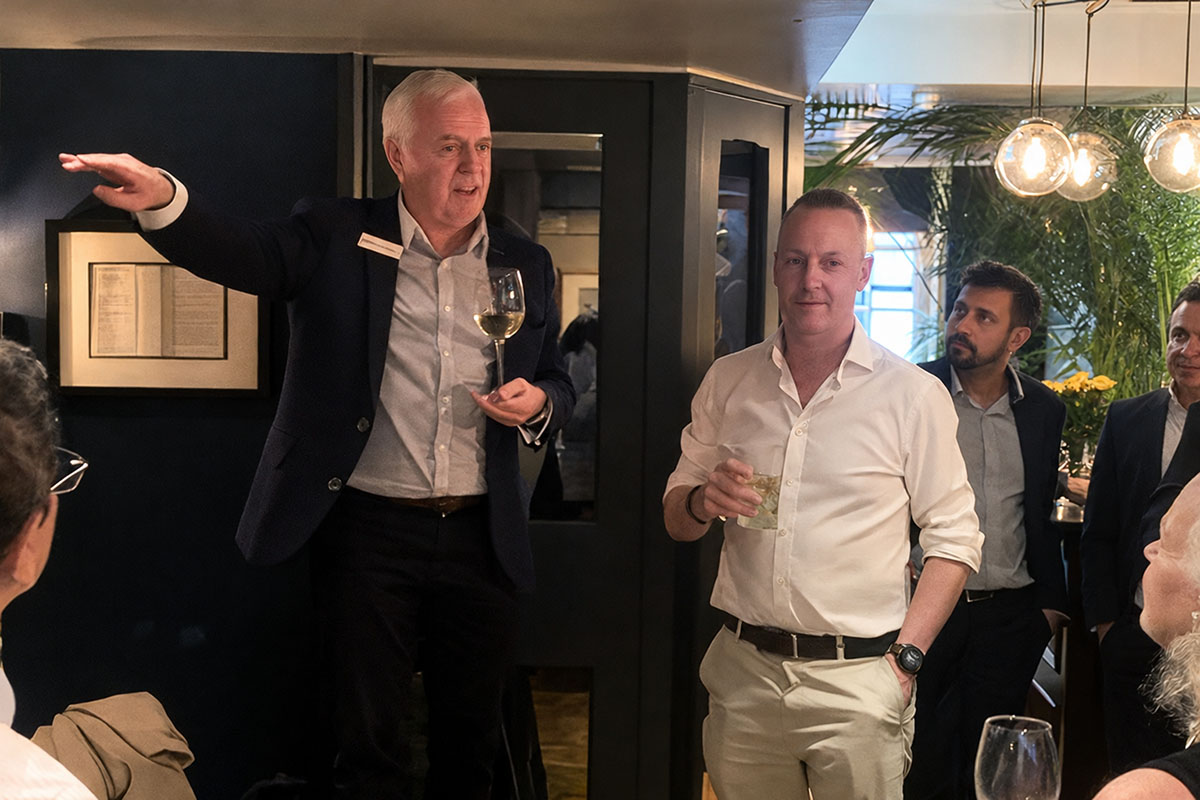 |
A big thank you to everyone who came along to our autumn drinks in London. It was a real pleasure to see so many familiar faces and to meet new ones and it was a particularly good chance for Graham, who was in town from Cape Town, to catch up with clients, partners and friends in person. We’re also very grateful to be a part of the Enterprise Investment Scheme Association which has helped us connect with a great number of extremely talented entrepreneurs and business owners in the UK. It has been a fantastic year, with many new partnerships and friendships formed and an evening like this is a reminder of how much of that comes down to good conversations. Thank you for making it such a success. We look forward to seeing you at the next one. |
Graham in Chicago
|
Graham also spent time in Chicago this September, where he met a number of fantastic founders and caught up with people from the wider exit and business community. He attended the Exit Planning Institute's Chicago chapter event, as well as a Small Giants gathering. Conversations like these are a good reminder of how much can be learned from owners and advisors working through the same questions on growth, succession and exit, whichever side of the Atlantic they are on. |
Until next time, The bizval team |
|
|
|
|
|


