|
|
Owning more of the chain: why vertical integration is commanding a valuation premium in 2026 |
|
|
|
For private equity sponsors, investment banks, and M&A advisors, the strategic move toward vertical integration has evolved from a growth narrative into a direct driver of valuation premiums. |
The Shift: from asset light efficiency model to a durable competitive advantage
|
For the better part of the 2010s, the asset-light model prevailed: outsource non-core activities, retain only what was essential, and rely on margin expansion. That approach was rational when supply chains were stable, tariffs predictable, and data was a secondary consideration. However, that environment no longer exists.
ASCM's Top 10 Supply Chain Trends in 2026 report identifies deep vertical integration as one of the defining strategic responses to geopolitical instability, tariff volatility, and the competitive imperative to control proprietary data. We’re seeing a structural reconfiguration of how businesses own and operate their value chains.
This is not a post-COVID reaction or a reshoring narrative. It's a structural shift that is reflected in corporate strategy and transaction multiples. PwC's Global Supply Chain Survey found that 83% of business leaders are now prioritizing operational control over pure outsourcing. When margin resilience is this demonstrable, valuations follow. |
Why Now: three forces driving the valuation premium
|
 |
The case for vertical integration is not new. What has changed is the convergence of three forces that make it directly legible to buyers in a sale process. |
1. Tariff uncertainty and margin protection Persistent trade tensions have elevated supply chain dependency from an operational issue to a core diligence concern. Buyers are scrutinizing vendor concentration, input cost exposure, and logistics dependencies with heightened rigor. Businesses that can demonstrate owned or locked-in supply at key stages of production are presenting a fundamentally different risk profile. That translates directly into how buyers model WACC and stress-test terminal value assumptions. 2. Regionalization and the reconfiguration of supply networks Strategy has evolved beyond geographic diversification. Entirely new manufacturing ecosystems are emerging across Africa, Mexico, Southeast Asia, and parts of the American Midwest. Mid-market industrials, food manufacturers, and specialist component providers positioned within these networks are finding that buyers assign meaningful value to that proximity. End-to-end control, in this context, isn't vertical in the traditional sense. It's about owning the critical node. 3. Data and AI as integration catalysts Hyperscalers have demonstrated this pattern at scale, vertically integrating AI infrastructure including chips, energy, and data centres for cost and performance advantages. Integrated operations generate richer, proprietary datasets that enhance demand forecasting, quality control, and customer analytics in ways that fragmented supply chains cannot replicate. For private equity sponsors underwriting growth into terminal value, that data advantage strengthens DCF assumptions. The media industry offers a sharp illustration: traditional production companies that outsourced distribution are being outcompeted by creator-owned end-to-end models that control the content, financing and the audience. |
The quantifiable impact on valuation metrics
|
 |
Deeper ownership of the value chain influences valuation through four interrelated channels. Understanding these channels distinguishes a robust fairness opinion from a generic precedent screen.
EBITDA margins and free-cash-flow conversion
Owning more of the value chain reduces margin erosion inherent in fragmented structures. The resulting improvement in margins flows through to free cash flow conversion, the primary driver of terminal value in DCF models. Higher margins, lower capex-to-revenue ratios, and more predictable working capital cycles all point in the same direction. Multiple expansion in comparable transactions
Mid-market multiples have remained relatively stable overall despite subdued deal volumes. But this is masking significant dispersion related to integration outcomes. Buyers apply a premium when the internalized stages thesis is quantifiable and defensible; valuation opinions must therefore substantiate that thesis rather than rely solely on market averages. WACC and risk reduction
Supply chain disruption risk is no longer a qualitative footnote in valuation reports. A business with owned critical inputs, diversified logistics, and demonstrated operational resilience presents a measurably lower systematic risk profile than a peer relying on single-source suppliers. For private equity diligence teams and their advisors, comparables analysis and DCF alignment is increasingly evident.
Strategic moat and premium exit multiples
Defensible IP, proprietary data pipelines, and tightly controlled quality standards justify exit multiples at the upper end of sector ranges. For investment banks, Big 4 advisories, and legal counsel structuring earn-outs, representations and warranties, or disclosure schedules, these attributes require clear documentation and support. |
Practical considerations in diligence
|
 |
Owning more of the value chain creates value, but it also has complexity. The questions that arise most frequently in diligence of integrated mid-market businesses are.
Execution risk and post-acquisition integration. Acquisitive integration (buying a supplier or distributor) differs from operational integration. A business that has acquired but not yet integrated carries execution risk that sophisticated buyers will price in. In valuation terms, this shows up as a higher discount rate applied to projected margin improvements, or a haircut on synergy assumptions. The key question: are the margin benefits demonstrable today, or do they depend on future integration milestones? Capex requirements and working-capital intensity. Deeper integration generally increases fixed asset bases and working capital needs. While margins usually justify the investment for deeply integrated businesses, mid-transition companies may show a temporary gap between EBITDA and free cash flow that must be explicitly addressed in valuation models. Over-integration and strategic inflexibility. Owning non-core stages of the value chain can create cost structures that are difficult to adjust when market conditions shift. This inflexibility reduces optionality in downside scenarios, which markets price into DCF analyses. International footnotes. The integration premium manifests differently across jurisdictions. In the United Kingdom, supply-chain restructuring has accelerated domestic integration in food processing and manufacturing, with buyers attributing value to resilience. In South Africa, these strategies intersect with B-BBEE ownership requirements, affecting capital structure and buyer pools. In the United States, export control regulations (particularly around semiconductors and AI infrastructure) have created both regulatory tailwinds and compliance costs, which must be reflected in risk-adjusted valuations.
|
The bottom line
|
 |
In 2026, the businesses pulling ahead are not uniformly larger or faster-growing. They're more integrated and can demonstrate why that integration is defensible. That demonstration is a valuation exercise as much as a strategy one.
For private equity sponsors, the integration premium is a core investment thesis. For owners of mid-market businesses preparing for an exit, the question worth asking is: ‘Which stages of your value chain are generating margin for third parties, and which of those can we internalize profitably?’ For M&A advisors and lawyers, it's a diligence priority and a disclosure imperative. The market data is consistent: businesses that own more of their economics (and can prove it) are commanding a structural premium over fragmented peers. Valuation methodology must reflect this reality, not merely cite precedent multiple.
The question for any exit-oriented owner isn't just "What are my margins?"
It's "Who else is earning margin on my revenue, and could I own that instead?" |
|
|
Recent podcasts
|
|
|
 |
What 11 years in Lagos taught Willem Haarhoff about building something that lasts.
In this episode, Graham speaks with Willem Haarhoff, Founder and CEO of DoughGetters and former KPMG partner, whose career took him from articles at 19 to leading large-scale audit operations across West Africa, before building his own business from the ground up. Willem talks honestly about what you lose when you step away from a global firm: the infrastructure, the systems, the safety net you never noticed until it was gone. He also talks about why the franchise model wasn't the original plan, why he chose remote-first long before it was mainstream, and what it means to design a business that can genuinely outlive its founder. His take on valuation is direct and worth hearing: most small business owners don't have a business. They have a job. Knowing the difference, and understanding what it takes to close that gap, is one of the most useful things any owner can do. Listen Here. |
|
|
Most business owners think they know what their business is worth. Most of them are wrong.
In this episode, Graham speaks with James Moody, Head of Valuations at PSG Capital and one of South Africa's most respected corporate financiers. James has spent his career working out what businesses are actually worth, and helping owners and investors act on that knowledge. James breaks down why fixating on a single metric (usually EBITDA) is one of the most common and costly mistakes owners make, why cash is the only number that truly matters, and what independent valuation actually looks like when it's done properly. It's a candid, practical conversation from someone who has sat across the table from founders, family business owners, and listed companies alike, and seen what separates the ones who really understand what they've built from those who only think they do. Listen Here.
|
|
|
What banks really look for: 35 years of funding wisdom with Gavin Ellis
Most business owners approach the bank the wrong way. Gavin Ellis spent 35 years on the other side of that table.
In this episode of the bizval Podcast, Graham Stephen sits down with Gavin Ellis, founder of GCE Business Solutions, a Johannesburg-based banking, funding and debt advisory firm. Gavin's career spans Standard Bank, ABSA and Barclays Africa, where he held executive roles in client acquisition for business and commercial banking across South Africa and the African continent.
Retrenched in his mid-50s, Gavin did not slow down. He launched GCE Business Solutions and has spent the past 7 years helping family-owned businesses navigate the funding landscape, structure their debt properly and access the banking relationships most owners simply cannot build on their own.
Listen Here.
|
Case study
|
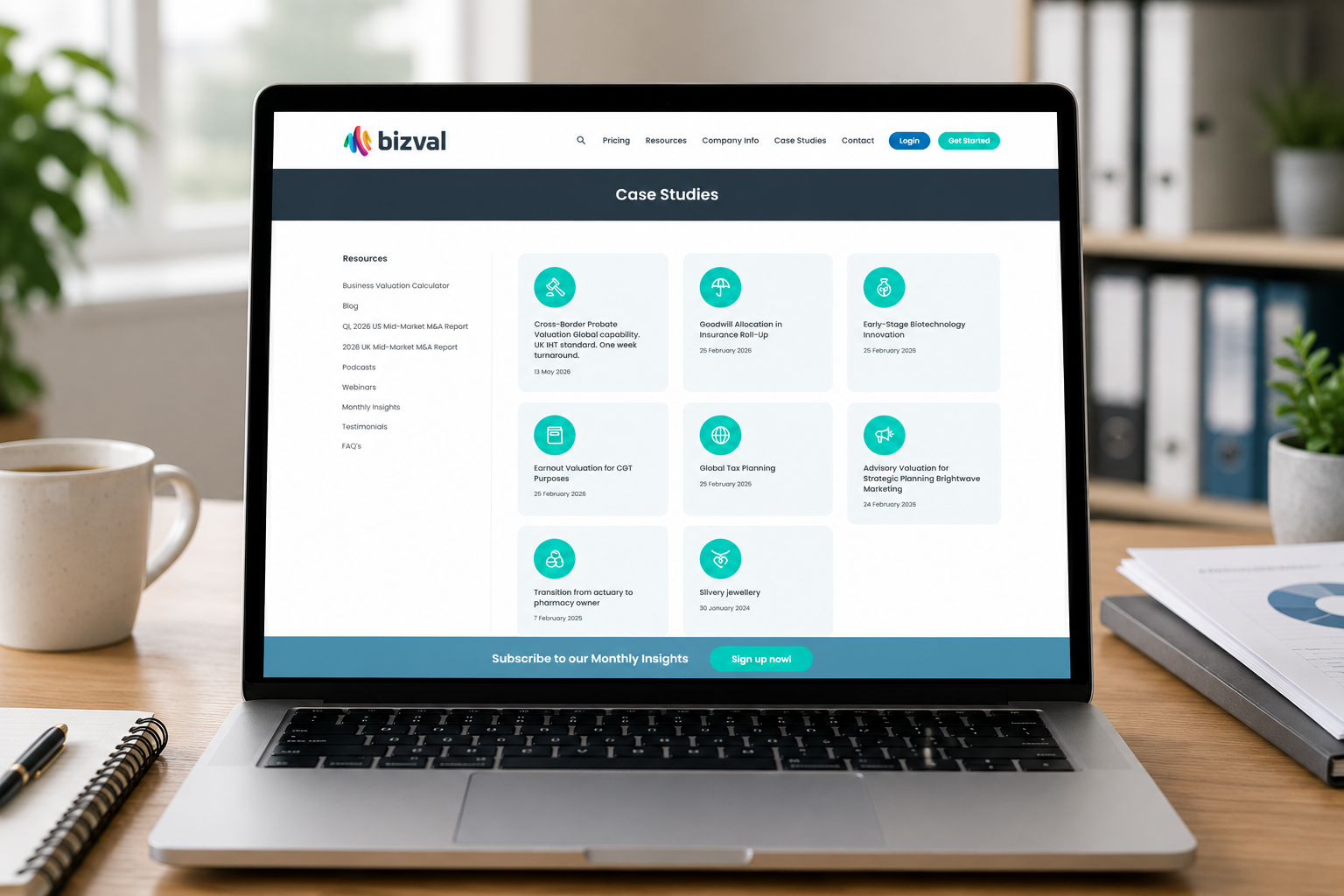 |
When a UK probate valuation spans three jurisdictions, a listed Asian stock exchange, and a one-week deadline, the methodology has to be airtight.
We recently valued a 22% shareholding in an offshore holding company whose primary asset was a quoted stake in a listed Asian specialty chemicals manufacturer. The instruction came through a UK chartered accountancy practice acting for executors of a deceased estate. The deceased held assets across multiple jurisdictions, the holding company was in voluntary liquidation, and the probate timetable left no room for delay.
The technical complexity was significant: a multi-layered offshore ownership structure, share prices quoted in a foreign currency requiring Bank of England exchange rate sourcing at the precise date of death, embedded capital gains tax in the listing jurisdiction that had to be deducted from net realisable value, and a discount analysis that required explicit justification rather than assumption.
Despite this, our robust methodology and systems allowed for our report to be delivered within one week. And this is what cross-border valuation capability looks like in practice: not as a bullet point on a capabilities page, but as a fully documented, HMRC-standard opinion of value that an accountant could put in front of the revenue authority with confidence.
Read the full case study here.
|
New from bizval: Mid-Market Macro and Geopolitical Report, May 2026
|
 |
The US mid-market valuation picture has split.
The Iran conflict and Strait of Hormuz disruption have pushed oil prices higher and kept inflation sticky, with the Fed on hold. Record private equity dry powder is providing some counterbalance.
This is creating a varied environment for US mid-market companies with some resilient, & others coming under pressure.
Our May 2026 proprietary report, prepared by Kyle McCulloch, Managing Director US, covers what is actually driving these divergences, where the capital is sitting and what sellers, buyers and executive teams should be doing about it right now.
Download the full report here.
|
|
|
What is your business really worth?
|
Most owners have a number in their head. Few have one they can explain with confidence.
bizval express gives business owners a fast, practical starting point for understanding value.
Enter a few key financial details and receive an indicative valuation range. From there, you can book a complimentary call with an expert to unpack the result and understand what it means.
It takes a few minutes to complete, but gives you a clearer starting point for future decisions.
|
| Try bizval express today. |
Until next time, The bizval team |
|
|
|
|
|