
Source: UK M&A Report
Transaction Overview
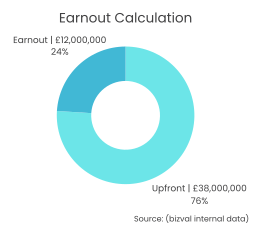
In mid-2025, bizval was engaged by the tax advisers to the shareholders of a UK-based publishing business undergoing a partial disposal. A significant proportion of the total consideration was structured as an earnout, contingent on the achievement of future performance targets. Under UK tax legislation, the earnout element required valuation at the date of completion to establish the capital gains tax (CGT) liability crystallising on disposal.
Key Challenges
Earnout provisions introduce material uncertainty, as the ultimate quantum received depends on the satisfaction of specified thresholds and performance metrics post-completion. The valuation needed to assess both the expected value of the contingent consideration and the degree of confidence in its receipt, while providing a robust and defensible position acceptable to HMRC.
Valuation Approach
Several methodologies were evaluated to address the contingent nature of the consideration, including Monte Carlo simulation, option pricing models (Black-Scholes), and scenario-based discounted cash flow analysis. Given the identifiable performance thresholds and availability of supporting data, a probability-weighted scenario approach was selected as the most appropriate. Five discrete scenarios were developed, each reflecting a plausible outcome ranging from outperformance to non-achievement of targets. Probabilities were assigned to each scenario based on rigorous analysis of historical trading performance, anticipated acquirer synergies, prevailing market conditions, and management forecasts. Expected cash flows under each scenario were discounted to present value using an appropriate risk-adjusted rate.
Outcome and Client Impact
The engagement produced a well-substantiated valuation of the earnout consideration, enabling the shareholders to settle their CGT liability on a basis closely aligned with the probable economic outcome. The transparent and evidence-based methodology provided a strong defence in the event of future HMRC enquiry, while facilitating efficient tax planning around the disposal proceeds. This case demonstrates the importance of applying sophisticated, scenario-driven valuation techniques to contingent consideration structures, delivering certainty for tax compliance in otherwise uncertain transactions.