

At a Glance
- Instruction type: Independent fair market valuation of 100% of the issued share capital of a UK financial planning practice, to support early-stage discussions with a prospective acquirer and broader succession planning.
- Subject interest: A three-adviser practice with two revenue streams: corporate employee benefits consultancy and private client wealth management.
- Methodology: Recurring-income multiple valuation of each revenue stream, weighted together with a whole-business EBITDA multiple and a discounted cash flow to reach the concluded value.
- Outcome: An independent report, concluding a defensible equity value supported by an internally developed book-quality scoring framework.
Background and Instruction
The Company is a long-established, FCA-authorised independent financial planning practice operating two distinct revenue lines: a corporate employee benefits consultancy advising employer clients on group pension, protection and medical insurance arrangements, and a smaller private client wealth management practice. All client relationships, assets under management and revenue for both streams sat with the same small team of advisers.
Management had entered early discussions with a prospective acquirer and needed an independently evidenced valuation to support those discussions, alongside broader succession planning given that concentration. bizval was instructed to value the entire issued share capital on a fair market value and going-concern basis, as at a valuation date of 31 March 2026.
Key Challenges
Challenge: Significant concentration within a small team of three advisers, with no restrictive covenants in place for either revenue stream, meant the entire client base, assets under management and revenue depended on a small number of individuals remaining in place.
Resolution: This was reflected explicitly through a dedicated adviser-concentration factor within a Book Quality Scorecard developed internally by bizval and tailored to valuations in this space, which fed mechanically into the multiples applied rather than being buried in a generic risk discount.
Challenge: Two structurally different revenue streams, contingent commission-linked corporate income and AUM-linked private wealth income, needed internally consistent but methodologically distinct treatment within a single instruction.
Resolution: Each stream was valued on the basis appropriate to it, separate fee and commission/trail multiples for the corporate book, and a blended recurring-income and AUM-based approach for the private client book, before being weighted together with the whole-business EBITDA multiple and discounted cash flow to reach the concluded value.
Challenge: Meaningful client concentration and an ageing private-client base were exactly the issues a prospective acquirer would probe hardest in due diligence.
Resolution: Both were quantified explicitly in a dedicated book-quality analysis, so the valuation anticipated the questions a buyer would raise rather than leaving them to be renegotiated later. The adviser-concentration and client-concentration factors were scored and weighted independently within the scorecard, to confirm neither risk was captured twice in the resulting multiple.
Valuation Complexity
- Limited forward visibility. No multi-year forecast existed beyond the current year’s budget, which complicated a conventional multi-year discounted cash flow.
- Owner-specific remuneration in the historical accounts. Owner-related remuneration, in the form of variable family salaries and pension contributions, needed to be normalised to a market-rate cost base before any multiple could be meaningfully applied to underlying earnings.
- Mixed income quality within a single stream. Fee income and commission/trail income within the corporate stream carried different durability and had to be capitalised at different multiples rather than a single blended rate.
- Translating qualitative risk into a specific multiple. Moving from qualitative book-quality factors, concentration, tenure, adviser concentration, income quality, client-age profile, to a specific, defensible multiple required a structured, evidence-based scoring framework rather than a subjective judgement call.
bizval’s Approach
bizval valued the practice by applying a recurring-income multiple to each revenue stream separately, then weighted the combined result together with a whole-business EBITDA multiple and a discounted cash flow to reach the concluded value. Reported financials were normalised to remove owner-specific remuneration and reflect a fully-loaded, market-rate cost base, ensuring the multiples applied were being tested against a realistic buyer’s earnings base rather than the reported numbers.
Central to the engagement was bizval’s Book Quality Scorecard: a weighted set of evidenced factors covering adviser concentration, client concentration, relationship tenure, income quality, client-age profile and regulatory record, among others, each scored independently on a consistent 0-10 basis to guard against double-counting related risks. Rather than selecting multiples subjectively, the composite score mechanically set the applied multiple within a market-sourced floor-to-ceiling range for each stream, so the final figures were a direct, transparent output of the underlying evidence.
Multiples and comparable ranges were sourced from private-company transaction data and published UK market commentary specific to financial-advice and wealth-management consolidation, and cross-referenced against the sector’s broader consolidation trends.
Why this approach: bizval considered the standard alternatives before adopting a recurring-income multiple weighted with a whole-business EBITDA multiple and a discounted cash flow. An asset-based approach did not fit, as the practice’s value derives from its client relationships and recurring income rather than its underlying assets. A single blended multiple across both revenue streams was considered but not adopted, as the corporate commission income and private client AUM income carry different durability and different market multiples, and blending them would have masked that distinction rather than reflected it.
The Outcome
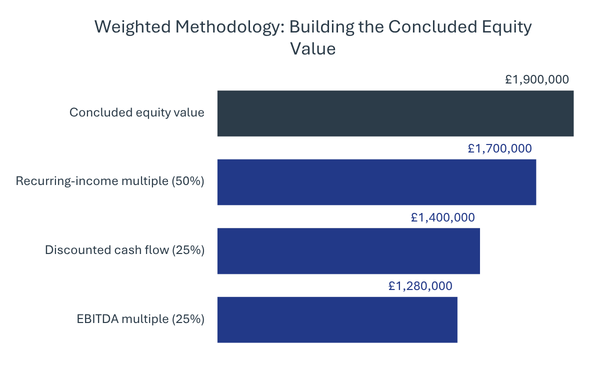
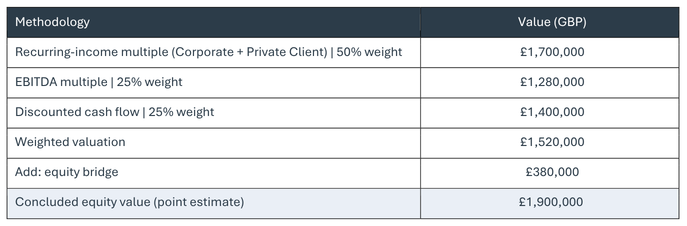
bizval’s recurring-income multiple valuation of the two revenue streams indicated a combined value of approximately £1,700,000 as at the valuation date, comprising £1,050,000 from the corporate employee benefits stream and £650,000 from the private client wealth management stream. This was weighted at 50% alongside a whole-business EBITDA multiple of approximately £1,280,000 (25% weight) and a discounted cash flow of approximately £1,400,000 (25% weight, its weighting held at the same level as the EBITDA multiple notwithstanding the absence of a multi-year forecast beyond the current year’s budget), producing a weighted valuation of approximately £1,520,000. The practice carried no borrowings. After adjusting for an equity bridge of £380,000, representing surplus investments held on the balance sheet, bizval concluded an equity value for 100% of the issued share capital of approximately £1,900,000, within a range of £1,720,000 to £2,080,000.
The report was delivered within two weeks of instruction, giving the shareholders an independently evidenced valuation to support their discussions with a prospective acquirer and their wider succession planning.
Valuation by Methodology
A recurring-income multiple values each revenue stream by applying a market-sourced multiple to its recurring income, corporate income and private client income separately, then adding the two together, rather than applying a single multiple to the business as a whole. The table below shows that result alongside the whole-business EBITDA multiple and the discounted cash flow (the present value of future cash flows the business is expected to generate). The three values were weighted 50%, 25% and 25% respectively, with the recurring-income result given the greatest weight as the most directly evidenced approach for a multi-stream business; the discounted cash flow’s weighting was held at the same 25% as the EBITDA multiple. The weighted result was then adjusted for the equity bridge to arrive at the concluded equity value.
What this demonstrates about bizval
Evidence-based, defensible multiples: Our Book Quality Scorecard turns qualitative due-diligence factors into a transparent, mechanical multiple selection, making the judgement transparent, evidenced and repeatable, and giving both buyer and seller a documented basis for every number.
Recurring-income rigour for multi-stream businesses: We are comfortable unpacking a business into its constituent revenue streams and applying the recurring-income multiple a specialist buyer would actually pay for each, rather than forcing a single blended methodology across fundamentally different income types.
Independence stakeholders can rely on: bizval had no financial interest in the outcome and charged no contingent fee. That independence meant the conclusion reflected bizval’s own evidenced judgement, rather than a position advocated by either the shareholders or the prospective acquirer.
Disclaimer: figures have been rebased and identifying details altered to preserve client confidentiality; the methodology described is as applied.